Showing posts with label Art Library. Show all posts

Thursday, October 14, 2021

Researching and Writing a Formal Research Paper

UCSB Library Art 1A Research Page:
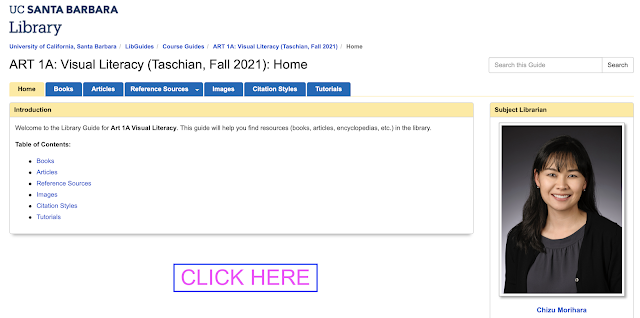

http://guides.library.ucsb.edu/art1a

Chizu Morihara (Art & Architecture Librarian):
cmorihara@ucsb.edu
(805) 893-2766

Paper Format (PAPER TOPIC HERE)
- 8 pages of text (this does NOT include the cover page, bibliography or images) 

- Double-spaced 

- Cover page 

- Footnotes or endnotes 

- Bibliography 

- Images (in a separate document at the end of the paper) 

- Use at least 8 different research sources (including peer reviewed 
journal articles, books, exhibition catalogs, monographs, etc.) 

- Use at least 10 citations 


- Upload an electronic copy of your paper (HERE) to the plagiarism scan in a WORD document (without pictures) and give your Teaching Assistant a hardcopy with pictures.

QUESTIONS TO ASK YOURSELF WHEN WRITING & EDITING YOUR PAPER:

1) Do I have the proper number of citations and sources?

2) Did I properly format my citations using MLA or Chicago?

3) Do I have a properly formatted formal bibliography?

4) Did I adhere to the proper paper length?

5) Do I have a clear, and specific thesis statement?

6) Does my thesis statement specifically relate to the final draft of my paper?

7) Did I run spell check (repeatedly)?

8) Did I carefully edit to make sure that I used proper grammar, and were my tenses consistent?

9) Did I formulate clear arguments and substantiate all of my claims with clear and concrete examples?

10) Did I avoid sweeping generalizations and vague assertions?

11) Did I use casual colloquial language in my formal research paper? If so, find more precise ways to describe the point being made.

12) Did I use scholarly research sources such as peer-reviewed journal articles, scholarly articles and books rather than sources such as blogs, Wikipedia, encyclopedias etc (that are not acceptable sources for a formal research paper).

13) Did I properly cite quotes and summaries of other people's intellectual property (footnotes and in-text citations)?

14) Did I avoid excessive biographical information about the artist? Instead I should only include biographical information that is directly relevant to their artistic practice.

15) Would anyone reading my paper understand what I am trying to convey, or do I need to more clearly define the scope of my research and ultimately the point of my paper?

16) Did I place the pictures at the end of my paper? If I embedded them in the text, I need to remove them and place them at the end of my paper.

17) Did I remember to remove the pictures from the electronic draft of my paper that I uploaded to the plagiarism scan?

18) Did I remember to upload my paper to the plagiarism scan (HERE), and give a hard copy to my Teaching Assistant (with the pictures)?

19) Did I remember to put my name, perm number and section time on my paper?

20) Did I remember to frequently save, backup and email drafts of my paper to myself (just in case my computer crashes)?

21) When I had questions, or needed help, did I reach out to my TA, professor or CLAS?


GENERAL TIPS ON WRITING YOUR PAPER:

1) The selection of a good thesis and supporting examples is an important part of producing a good paper. Be selective. The paper is about how to look closely at works of art and how your evaluation of objects and images is expanded by the specific context in which they are presented.

2) Write primarily with nouns and verbs. Avoid unnecessary (especially vague and imprecise) adjectives and adverbs.

3) Revise and rewrite. Proofread your work. Do not rely solely on "spell check."


4) Use the dictionary to refer to words you do not fully understand.

5) Do not overstate, or excessively use qualifiers (such as very, rather, little, etc.). 


6) Use orthodox diction and accurate spelling. ("Its" is possessive; "It's" is a contraction for "it is," "Its' " doesn't exist. "Their" is possessive, "They're" is a contraction of "they are," There is declarative).

7) Be clear. Make references clearly. (Do not use the word "this" as the subject of a sentence).

8) Do not let your opinions get in the way of your writing.

9) Avoid using Wikipedia, blogs, newspaper articles and other materials that are not scholarly. These ARE NOT research materials for a formal research paper.

10) Get to the point quickly. Concentrate on quality of writing not quantity of words.

11) For help with formatting MLA and Chicago citations, visit Purdue Owlhttps://owl.purdue.edu/owl/purdue_owl.html

For help writing the paper contact CLAS at 893-3269. They have a writing lab that will help you with papers, and will even proofread your papers. They also offer help specifically to students for whom English is a second language. CLAS site: http://www.clas.sa.ucsb.edu/

Thursday, October 7, 2021

Scholarly Research Training Workshop on Tuesday, October 19

WHAT: Art 1A Scholarly Research Training Workshop

WHOChizu Morihara

WHENTuesday, October 19 from 12:30-1:45 (in class)


Writing a formal research paper requires finding appropriate scholarly articles, peer-reviewed journal articles and books. Sources such as blogs, newspaper articles, unauthorized websites, random papers uploaded to the internet, random YouTube videos, Wikipedia and encyclopedias (including Grove Art Online) 
are not appropriate resources to cite in formal research papers.

Your research materials should largely be procured from Davidson Library, and you will note that Chizu Morihara, our Art & Architecture Librarian, has created a special page for Art 1A Visual Literacy.

Art 1A Visual Literacy Library Homepage:

Other Helpful Library Resources:

Friday, January 8, 2021

WRITING A FORMAL RESEARCH PAPER

UCSB Library Art 1A Research Page:

http://guides.library.ucsb.edu/art1a

Chizu Morihara (Art & Architecture Librarian):
cmorihara@ucsb.edu
(805) 893-2766

Paper Format (PAPER TOPIC HERE)
- 8 pages of text (this does NOT include the cover page, bibliography or images) 

- Double-spaced 

- Cover page 

- Footnotes or endnotes 

- Bibliography 

- Images (in a separate document at the end of the paper) 

- Use at least 8 different research sources (including peer reviewed 
journal articles, books, exhibition catalogs, monographs, etc.) 

- Use at least 10 citations 


- Upload an electronic copy of your paper (HERE) to the plagiarism scan in a WORD document (without pictures) and give your Teaching Assistant a hardcopy with pictures.

QUESTIONS TO ASK YOURSELF WHEN WRITING & EDITING YOUR PAPER:

1) Do I have the proper number of citations and sources?

2) Did I properly format my citations using MLA or Chicago?

3) Do I have a properly formatted formal bibliography?

4) Did I adhere to the proper paper length?

5) Do I have a clear, and specific thesis statement?

6) Does my thesis statement specifically relate to the final draft of my paper?

7) Did I run spell check (repeatedly)?

8) Did I carefully edit to make sure that I used proper grammar, and were my tenses consistent?

9) Did I formulate clear arguments and substantiate all of my claims with clear and concrete examples?

10) Did I avoid sweeping generalizations and vague assertions?

11) Did I use casual colloquial language in my formal research paper? If so, find more precise ways to describe the point being made.

12) Did I use scholarly research sources such as peer-reviewed journal articles, scholarly articles and books rather than sources such as blogs, Wikipedia, encyclopedias etc (that are not acceptable sources for a formal research paper).

13) Did I properly cite quotes and summaries of other people's intellectual property (footnotes and in-text citations)?

14) Did I avoid excessive biographical information about the artist? Instead I should only include biographical information that is directly relevant to their artistic practice.

15) Would anyone reading my paper understand what I am trying to convey, or do I need to more clearly define the scope of my research and ultimately the point of my paper?

16) Did I place the pictures at the end of my paper? If I embedded them in the text, I need to remove them and place them at the end of my paper.

17) Did I remember to remove the pictures from the electronic draft of my paper that I uploaded to the plagiarism scan?

18) Did I remember to upload my paper to the plagiarism scan (HERE), and give a hard copy to my Teaching Assistant (with the pictures)?

19) Did I remember to put my name, perm number and section time on my paper?

20) Did I remember to frequently save, backup and email drafts of my paper to myself (just in case my computer crashes)?

21) When I had questions, or needed help, did I reach out to my TA, professor or CLAS?


GENERAL TIPS ON WRITING YOUR PAPER:

1) The selection of a good thesis and supporting examples is an important part of producing a good paper. Be selective. The paper is about how to look closely at works of art and how your evaluation of objects and images is expanded by the specific context in which they are presented.

2) Write primarily with nouns and verbs. Avoid unnecessary (especially vague and imprecise) adjectives and adverbs.

3) Revise and rewrite. Proofread your work. Do not rely solely on "spell check."


4) Use the dictionary to refer to words you do not fully understand.

5) Do not overstate, or excessively use qualifiers (such as very, rather, little, etc.). 


6) Use orthodox diction and accurate spelling. ("Its" is possessive; "It's" is a contraction for "it is," "Its' " doesn't exist. "Their" is possessive, "They're" is a contraction of "they are," There is declarative).

7) Be clear. Make references clearly. (Do not use the word "this" as the subject of a sentence).

8) Do not let your opinions get in the way of your writing.

9) Avoid using Wikipedia, blogs, newspaper articles and other materials that are not scholarly. These ARE NOT research materials for a formal research paper.

10) Get to the point quickly. Concentrate on quality of writing not quantity of words.

11) For help with formatting MLA and Chicago citations, visit Purdue Owlhttps://owl.purdue.edu/owl/purdue_owl.html

For help writing the paper contact CLAS at 893-3269. They have a writing lab that will help you with papers, and will even proofread your papers. They also offer help specifically to students for whom English is a second language. CLAS site: http://www.clas.sa.ucsb.edu/

Friday, October 9, 2020

Scholarly Research Training Workshop on Tuesday, October 27 from 12:30-1:45

WHAT: Scholarly Research Training Workshop

WHO: Chizu Morihara

WHEN: Tuesday, October 27 from 12:30-1:45


Writing a formal research paper requires finding appropriate scholarly articles, peer-reviewed journal articles and books. Sources such as blogs, newspaper articles, unauthorized websites, random papers uploaded to the internet, random YouTube videos, Wikipedia and encyclopedias (including Grove Art Online) 
are not appropriate resources to cite in formal research papers. Click HERE to learn about the pickup and mail delivery service that is available for UCSB students, faculty and staff.

Your research materials should largely be procured from Davidson Library, and you will note that Chizu Morihara, our Art & Architecture Librarian, has created a special page for Art 1A Visual Literacy.

Art 1A Visual Literacy Library Homepage:

Other Helpful Library Resources:

Chizu Morihara is available to help you find your research materials for your Glenn Ligon research paper. Chizu can help you via email or Zoom. Email her for help, she is waiting to hear from you.
Chizu Morihara
UCSB Art & Architecture Library
Univ. of California, Santa Barbara
Santa Barbara, CA 93106-9010
(805) 893-2766

Tuesday, January 19, 2016

Dates to Remember for Art 1A (UPDATES)

Monday, January 25: Scholarly Research Training Workshop for Art 1A. Meet at the Instruction & Training Room 1575 Davidson Library. Details here. Please arrive on time.

Monday, February 1 Lecture: Semiotics (Art & Advertising). You need to submit the Chandler and Barthes reading summaries this week.

Wednesday, February 3 Lecture: Semiotics (Film)

Wednesday, February 10: Research Paper #1 Due (Note that you have been given an extra week to utilize what you learned in the Research Workshop). In addition to handing in a hard copy to your TA, you will need to upload a copy to the Plagiarism Scan here. The images that you include in your paper should not be uploaded to the Plagiarism Scan.

You will not be responsible for doing the writing summaries that would have been due that week. Instead, I want you to concentrate all of your attention on your research paper, but if you really want to do summaries for these two essays– then they will count as extra credit.

Saturday, February 20: Museum Field Trip. The Wednesday, February 17 lecture will be cancelled in lieu of this trip. However, be sure to attend your sections this week. Your reading summaries will be due in section. 

Please make sure that you give your TA your completed Liability Waiver Form. We will be handing these forms out to you beginning this week. 

If you want to get a ride to the museum in one of our two UCSB vans, then be sure to let your TA know, and submit your completed waiver as soon as possible.

Open up a Twitter account, if you don't already have one! You will be using Twitter on the museum trip. Here is the Art 1A Twitter Account, and here is the handle: @Art1AUCSB

Friday, January 15, 2016

Scholarly Research Training Workshop for Art 1A

New Art & Architecture Library at UCSB (ground floor at Davidson Library

On Monday, January 25 our class lecture will be held at Davidson Library in room 1575 in the old part of the library. Please be sure to arrive on time. Following the training with Art Librarian, L. Chizu Morihara, we will take a brief tour of the Art & Architecture collection (shown above).