Showing posts with label Research Paper. Show all posts

Wednesday, April 9, 2025

Mechanics of a Formal Research Paper & Scholarly Research Training Workshops

Mechanics of a Formal Research Workshop: Monday, Aril 21 at 12:30 in lecture.

Scholarly Research Training WorkshopWednesday, April 23 at 12:30 in lecture with Heather Nisen.

Heather Nisen (Art & Architecture Librarian):
hnisen@ucsb.edu
http://guides.library.ucsb.edu/art1a
(805) 893-3026

Here is the link to the plagiarism tutorial that the Teaching & Learning Department created:

Paper Format (PAPER TOPIC HERE)

- 9-10 pages of text (this does NOT include the cover page, bibliography or images)
- Double-spaced
- Cover page
- Footnotes or endnotes
- Bibliography
- Images (at the end of the paper)
- Use at least 10 different research sources (including peer reviewed 
journal articles, books, exhibition catalogs, monographs, etc.)
- Use at least 10-15 citations

QUESTIONS TO ASK YOURSELF WHEN WRITING & EDITING YOUR PAPER:

1) Do I have the proper number of citations and sources?

2) Did I properly format my citations using MLA or Chicago?

3) Do I have a properly formatted formal bibliography?

4) Did I adhere to the proper paper length?

5) Do I have a clear, and specific thesis statement?

6) Does my thesis statement specifically relate to the final draft of my paper?

7) Did I run spell check (repeatedly)?

8) Did I carefully edit to make sure that I used proper grammar, and were my tenses consistent?

9) Did I formulate clear arguments and substantiate all of my claims with clear and concrete examples?

10) Did I avoid sweeping generalizations and vague assertions?

11) Did I use casual colloquial language in my formal research paper? If so, find more precise ways to describe the point being made.

12) Did I use scholarly research sources such as peer-reviewed journal articles, scholarly articles and books rather than sources such as blogs, Wikipedia, encyclopedias etc (that are not acceptable sources for a formal research paper).

13) Did I properly cite quotes and summaries of other people's intellectual property (footnotes and in-text citations)?

14) Did I avoid excessive biographical information about the artist? Instead I should only include biographical information that is directly relevant to their artistic practice.

15) Would anyone reading my paper understand what I am trying to convey, or do I need to more clearly define the scope of my research and ultimately the point of my paper?

16) Did I place the pictures at the end of my paper? If I embedded them in the text, I need to remove them and place them at the end of my paper.

17) Did I remember to put my name, perm number and section time on my paper?

18) Did I remember to frequently save, backup and email drafts of my paper to myself (just in case my computer crashes)?

19) When I had questions, or needed help, did I reach out to my TA, professor or CLAS?

GENERAL TIPS ON WRITING YOUR PAPER:

1) The selection of a good thesis and supporting examples is an important part of producing a good paper. Be selective. The paper is about how to look closely at works of art and how your evaluation of objects and images is expanded by the specific context in which they are presented.

2) Write primarily with nouns and verbs. Avoid unnecessary (especially vague and imprecise) adjectives and adverbs.

3) Revise and rewrite. Proofread your work. Do not rely solely on "spell check."

4) Use the dictionary to refer to words you do not fully understand.

5) Do not overstate, or excessively use qualifiers (such as very, rather, little, etc.).

6) Use orthodox diction and accurate spelling. ("Its" is possessive; "It's" is a contraction for "it is," "Its' " doesn't exist. "Their" is possessive, "They're" is a contraction of "they are," There is declarative).

7) Be clear. Make references clearly. (Do not use the word "this" as the subject of a sentence).

8) Do not let your opinions get in the way of your writing.

9) Avoid using Wikipedia, blogs, newspaper articles and other materials that are not scholarly. These ARE NOT research materials for a formal research paper.

10) Get to the point quickly. Concentrate on quality of writing not quantity of words.

11) For help with formatting MLA and Chicago citations, visit Purdue Owlhttps://owl.purdue.edu/owl/purdue_owl.html

For help writing the paper contact CLAS at 893-3269. They have a writing lab that will help you with papers, and will even proofread your papers. They also offer help specifically to students for whom English is a second language. CLAS site: http://www.clas.sa.ucsb.edu/

Wednesday, January 25, 2023

Mechanics of a Formal Research Paper Workshop on Wednesday, February 1

http://guides.library.ucsb.edu/art1a

Chizu Morihara (Art & Architecture Librarian):
cmorihara@ucsb.edu
(805) 893-2766

Paper Format (PAPER TOPIC HERE)

- 8 pages of text (this does NOT include the cover page, bibliography or images)
- Double-spaced
- Cover page
- Footnotes or endnotes
- Bibliography
- Images (in a separate document at the end of the paper)
- Use at least 8 different research sources (including peer reviewed 
journal articles, books, exhibition catalogs, monographs, etc.)
- Use at least 10 citations
- Upload an electronic copy of your paper (HERE) to the plagiarism scan in a WORD document (without pictures) and give your Teaching Assistant a hardcopy with pictures.

QUESTIONS TO ASK YOURSELF WHEN WRITING & EDITING YOUR PAPER:

1) Do I have the proper number of citations and sources?

2) Did I properly format my citations using MLA or Chicago?

3) Do I have a properly formatted formal bibliography?

4) Did I adhere to the proper paper length?

5) Do I have a clear, and specific thesis statement?

6) Does my thesis statement specifically relate to the final draft of my paper?

7) Did I run spell check (repeatedly)?

8) Did I carefully edit to make sure that I used proper grammar, and were my tenses consistent?

9) Did I formulate clear arguments and substantiate all of my claims with clear and concrete examples?

10) Did I avoid sweeping generalizations and vague assertions?

11) Did I use casual colloquial language in my formal research paper? If so, find more precise ways to describe the point being made.

12) Did I use scholarly research sources such as peer-reviewed journal articles, scholarly articles and books rather than sources such as blogs, Wikipedia, encyclopedias etc (that are not acceptable sources for a formal research paper).

13) Did I properly cite quotes and summaries of other people's intellectual property (footnotes and in-text citations)?

14) Did I avoid excessive biographical information about the artist? Instead I should only include biographical information that is directly relevant to their artistic practice.

15) Would anyone reading my paper understand what I am trying to convey, or do I need to more clearly define the scope of my research and ultimately the point of my paper?

16) Did I place the pictures at the end of my paper? If I embedded them in the text, I need to remove them and place them at the end of my paper.

17) Did I remember to remove the pictures from the electronic draft of my paper that I uploaded to the plagiarism scan?

18) Did I remember to upload my paper to the plagiarism scan (HERE), and give a hard copy to my Teaching Assistant (with the pictures)?

19) Did I remember to put my name, perm number and section time on my paper?

20) Did I remember to frequently save, backup and email drafts of my paper to myself (just in case my computer crashes)?

21) When I had questions, or needed help, did I reach out to my TA, professor or CLAS?

GENERAL TIPS ON WRITING YOUR PAPER:

1) The selection of a good thesis and supporting examples is an important part of producing a good paper. Be selective. The paper is about how to look closely at works of art and how your evaluation of objects and images is expanded by the specific context in which they are presented.

2) Write primarily with nouns and verbs. Avoid unnecessary (especially vague and imprecise) adjectives and adverbs.

3) Revise and rewrite. Proofread your work. Do not rely solely on "spell check."

4) Use the dictionary to refer to words you do not fully understand.

5) Do not overstate, or excessively use qualifiers (such as very, rather, little, etc.).

6) Use orthodox diction and accurate spelling. ("Its" is possessive; "It's" is a contraction for "it is," "Its' " doesn't exist. "Their" is possessive, "They're" is a contraction of "they are," There is declarative).

7) Be clear. Make references clearly. (Do not use the word "this" as the subject of a sentence).

8) Do not let your opinions get in the way of your writing.

9) Avoid using Wikipedia, blogs, newspaper articles and other materials that are not scholarly. These ARE NOT research materials for a formal research paper.

10) Get to the point quickly. Concentrate on quality of writing not quantity of words.

11) For help with formatting MLA and Chicago citations, visit Purdue Owlhttps://owl.purdue.edu/owl/purdue_owl.html

For help writing the paper contact CLAS at 893-3269. They have a writing lab that will help you with papers, and will even proofread your papers. They also offer help specifically to students for whom English is a second language. CLAS site: http://www.clas.sa.ucsb.edu/

Friday, October 7, 2022

Mechanics of a Formal Research Paper Workshop on Tuesday, October 18


http://guides.library.ucsb.edu/art1a

Chizu Morihara (Art & Architecture Librarian):
cmorihara@ucsb.edu
(805) 893-2766
Paper Format (PAPER TOPIC HERE)
- 8 pages of text (this does NOT include the cover page, bibliography or images)
- Double-spaced
- Cover page
- Footnotes or endnotes
- Bibliography
- Images (in a separate document at the end of the paper)
- Use at least 8 different research sources (including peer reviewed 
journal articles, books, exhibition catalogs, monographs, etc.)
- Use at least 10 citations
- Upload an electronic copy of your paper (HERE) to the plagiarism scan in a WORD document (without pictures) and give your Teaching Assistant a hardcopy with pictures.

QUESTIONS TO ASK YOURSELF WHEN WRITING & EDITING YOUR PAPER:

1) Do I have the proper number of citations and sources?

2) Did I properly format my citations using MLA or Chicago?

3) Do I have a properly formatted formal bibliography?

4) Did I adhere to the proper paper length?

5) Do I have a clear, and specific thesis statement?

6) Does my thesis statement specifically relate to the final draft of my paper?

7) Did I run spell check (repeatedly)?

8) Did I carefully edit to make sure that I used proper grammar, and were my tenses consistent?

9) Did I formulate clear arguments and substantiate all of my claims with clear and concrete examples?

10) Did I avoid sweeping generalizations and vague assertions?

11) Did I use casual colloquial language in my formal research paper? If so, find more precise ways to describe the point being made.

12) Did I use scholarly research sources such as peer-reviewed journal articles, scholarly articles and books rather than sources such as blogs, Wikipedia, encyclopedias etc (that are not acceptable sources for a formal research paper).

13) Did I properly cite quotes and summaries of other people's intellectual property (footnotes and in-text citations)?

14) Did I avoid excessive biographical information about the artist? Instead I should only include biographical information that is directly relevant to their artistic practice.

15) Would anyone reading my paper understand what I am trying to convey, or do I need to more clearly define the scope of my research and ultimately the point of my paper?

16) Did I place the pictures at the end of my paper? If I embedded them in the text, I need to remove them and place them at the end of my paper.

17) Did I remember to remove the pictures from the electronic draft of my paper that I uploaded to the plagiarism scan?

18) Did I remember to upload my paper to the plagiarism scan (HERE), and give a hard copy to my Teaching Assistant (with the pictures)?

19) Did I remember to put my name, perm number and section time on my paper?

20) Did I remember to frequently save, backup and email drafts of my paper to myself (just in case my computer crashes)?

21) When I had questions, or needed help, did I reach out to my TA, professor or CLAS?


GENERAL TIPS ON WRITING YOUR PAPER:

1) The selection of a good thesis and supporting examples is an important part of producing a good paper. Be selective. The paper is about how to look closely at works of art and how your evaluation of objects and images is expanded by the specific context in which they are presented.

2) Write primarily with nouns and verbs. Avoid unnecessary (especially vague and imprecise) adjectives and adverbs.

3) Revise and rewrite. Proofread your work. Do not rely solely on "spell check."

4) Use the dictionary to refer to words you do not fully understand.

5) Do not overstate, or excessively use qualifiers (such as very, rather, little, etc.).

6) Use orthodox diction and accurate spelling. ("Its" is possessive; "It's" is a contraction for "it is," "Its' " doesn't exist. "Their" is possessive, "They're" is a contraction of "they are," There is declarative).

7) Be clear. Make references clearly. (Do not use the word "this" as the subject of a sentence).

8) Do not let your opinions get in the way of your writing.

9) Avoid using Wikipedia, blogs, newspaper articles and other materials that are not scholarly. These ARE NOT research materials for a formal research paper.

10) Get to the point quickly. Concentrate on quality of writing not quantity of words.

11) For help with formatting MLA and Chicago citations, visit Purdue Owlhttps://owl.purdue.edu/owl/purdue_owl.html

For help writing the paper contact CLAS at 893-3269. They have a writing lab that will help you with papers, and will even proofread your papers. They also offer help specifically to students for whom English is a second language. CLAS site: http://www.clas.sa.ucsb.edu/

Thursday, June 30, 2022

Writing a Formal Research Paper


http://guides.library.ucsb.edu/art1a

Chizu Morihara (Art & Architecture Librarian):
cmorihara@ucsb.edu
(805) 893-2766

Paper Format (PAPER TOPIC HERE)
- 8 pages of text (this does NOT include the cover page, bibliography or images) 

- Double-spaced 

- Cover page 

- Footnotes or endnotes 

- Bibliography 

- Images (in a separate document at the end of the paper) 

- Use at least 8 different research sources (including peer reviewed 
journal articles, books, exhibition catalogs, monographs, etc.) 

- Use at least 10 citations 


- Upload an electronic copy of your paper (HERE) to the plagiarism scan in a WORD document (without pictures) and give your Teaching Assistant a hardcopy with pictures.

QUESTIONS TO ASK YOURSELF WHEN WRITING & EDITING YOUR PAPER:

1) Do I have the proper number of citations and sources?

2) Did I properly format my citations using MLA or Chicago?

3) Do I have a properly formatted formal bibliography?

4) Did I adhere to the proper paper length?

5) Do I have a clear, and specific thesis statement?

6) Does my thesis statement specifically relate to the final draft of my paper?

7) Did I run spell check (repeatedly)?

8) Did I carefully edit to make sure that I used proper grammar, and were my tenses consistent?

9) Did I formulate clear arguments and substantiate all of my claims with clear and concrete examples?

10) Did I avoid sweeping generalizations and vague assertions?

11) Did I use casual colloquial language in my formal research paper? If so, find more precise ways to describe the point being made.

12) Did I use scholarly research sources such as peer-reviewed journal articles, scholarly articles and books rather than sources such as blogs, Wikipedia, encyclopedias etc (that are not acceptable sources for a formal research paper).

13) Did I properly cite quotes and summaries of other people's intellectual property (footnotes and in-text citations)?

14) Did I avoid excessive biographical information about the artist? Instead I should only include biographical information that is directly relevant to their artistic practice.

15) Would anyone reading my paper understand what I am trying to convey, or do I need to more clearly define the scope of my research and ultimately the point of my paper?

16) Did I place the pictures at the end of my paper? If I embedded them in the text, I need to remove them and place them at the end of my paper.

17) Did I remember to remove the pictures from the electronic draft of my paper that I uploaded to the plagiarism scan?

18) Did I remember to upload my paper to the plagiarism scan (HERE), and give a hard copy to my Teaching Assistant (with the pictures)?

19) Did I remember to put my name, perm number and section time on my paper?

20) Did I remember to frequently save, backup and email drafts of my paper to myself (just in case my computer crashes)?

21) When I had questions, or needed help, did I reach out to my TA, professor or CLAS?


GENERAL TIPS ON WRITING YOUR PAPER:

1) The selection of a good thesis and supporting examples is an important part of producing a good paper. Be selective. The paper is about how to look closely at works of art and how your evaluation of objects and images is expanded by the specific context in which they are presented.

2) Write primarily with nouns and verbs. Avoid unnecessary (especially vague and imprecise) adjectives and adverbs.

3) Revise and rewrite. Proofread your work. Do not rely solely on "spell check."


4) Use the dictionary to refer to words you do not fully understand.

5) Do not overstate, or excessively use qualifiers (such as very, rather, little, etc.). 


6) Use orthodox diction and accurate spelling. ("Its" is possessive; "It's" is a contraction for "it is," "Its' " doesn't exist. "Their" is possessive, "They're" is a contraction of "they are," There is declarative).

7) Be clear. Make references clearly. (Do not use the word "this" as the subject of a sentence).

8) Do not let your opinions get in the way of your writing.

9) Avoid using Wikipedia, blogs, newspaper articles and other materials that are not scholarly. These ARE NOT research materials for a formal research paper.

10) Get to the point quickly. Concentrate on quality of writing not quantity of words.

11) For help with formatting MLA and Chicago citations, visit Purdue Owlhttps://owl.purdue.edu/owl/purdue_owl.html

For help writing the paper contact CLAS at 893-3269. They have a writing lab that will help you with papers, and will even proofread your papers. They also offer help specifically to students for whom English is a second language. CLAS site: http://www.clas.sa.ucsb.edu/

Monday, April 18, 2022

Kerry James Marshall

According to Art 21, 

Kerry James Marshall was born in 1955 in Birmingham, Alabama, and was educated at the Otis Art Institute in Los Angeles, from which he received a BFA, and an honorary doctorate (1999).

The subject matter of his paintings, installations, and public projects is often drawn from African American popular culture, and is rooted in the geography of his upbringing: “You can’t be born in Birmingham, Alabama, in 1955 and grow up in South Central [Los Angeles] near the Black Panthers headquarters, and not feel like you’ve got some kind of social responsibility. You can’t move to Watts in 1963 and not speak about it. That determined a lot of where my work was going to go,” says Marshall.

In his Souvenir series of paintings and sculptures, he pays tribute to the civil rights movement with mammoth printing stamps featuring bold slogans of the era (“Black Power!”) and paintings of middle-class living rooms, where ordinary African-American citizens have become angels tending to a domestic order populated by the ghosts of Martin Luther King, Jr., John F. Kennedy, Robert Kennedy, and other heroes of the 1960s. In RYTHM MASTR, Marshall creates a comic book for the twenty-first century, pitting ancient African sculptures come to life against a cyberspace elite that risks losing touch with traditional culture.

Marshall’s work is based on a broad range of art-historical references, from Renaissance painting to black folk art, from El Greco to Charles White. A striking aspect of Marshall’s paintings is the emphatically black skin tone of his figures—a development the artist says emerged from an investigation into the invisibility of Black people in America and the unnecessarily negative connotations associated with darkness. Marshall believes, “You still have to earn your audience’s attention every time you make something.” The sheer beauty of his work speaks to an art that is simultaneously formally rigorous and socially engaged. Marshall lives and works in Chicago. (Art 21)

Formal Research Paper Prompt on Kerry James Marshall HERE.

Tate Talks (2018) 1:32:50

https://www.youtube.com/watch?v=4c4Z3U8WVLQ
https://www.tate.org.uk/art/artists/kerry-james-marshall-12766/kerry-james-marshall-conversation

MOCA 
Kerry James Marshall and Helen Molesworth in Conversation (2017)1:20:58

MOCA Exhibition Kerry James Marshall: Mastry:
https://www.moca.org/exhibition/kerry-james-marshall-mastry

Paint it Black Interview Louisiana Channel 2014 (10:19)
https://www.youtube.com/watch?v=9wNTN3MaLTY

Interview Apollo Magazine:
https://www.apollo-magazine.com/kerry-james-marshall-interview/

Art 21:
https://art21.org/artist/kerry-james-marshall/

Hyperallergic article: How Kerry James Marshall Rewrites Art History

If you have HBO, then it is worth watching the documentary Black Art: In the Absence of Light. Kerry James Marshall is prominently featured and interviewed in this documentary.

Another interesting documentary that you may watch, on HULU, is Summer of Soul by Ahmir "Questlove" Thompson.

Tuesday, April 12, 2022

The Researching and Writing a Formal Research Paper: Thursday, April 21


Meeting via Zoom:

http://guides.library.ucsb.edu/art1a

Chizu Morihara (Art & Architecture Librarian):
cmorihara@ucsb.edu
(805) 893-2766

Paper Format (PAPER TOPIC HERE)
- 8 pages of text (this does NOT include the cover page, bibliography or images) 

- Double-spaced 

- Cover page 

- Footnotes or endnotes 

- Bibliography 

- Images (in a separate document at the end of the paper) 

- Use at least 8 different research sources (including peer reviewed 
journal articles, books, exhibition catalogs, monographs, etc.) 

- Use at least 10 citations 


- Upload an electronic copy of your paper (HERE) to the plagiarism scan in a WORD document (without pictures) and give your Teaching Assistant a hardcopy with pictures.

QUESTIONS TO ASK YOURSELF WHEN WRITING & EDITING YOUR PAPER:

1) Do I have the proper number of citations and sources?

2) Did I properly format my citations using MLA or Chicago?

3) Do I have a properly formatted formal bibliography?

4) Did I adhere to the proper paper length?

5) Do I have a clear, and specific thesis statement?

6) Does my thesis statement specifically relate to the final draft of my paper?

7) Did I run spell check (repeatedly)?

8) Did I carefully edit to make sure that I used proper grammar, and were my tenses consistent?

9) Did I formulate clear arguments and substantiate all of my claims with clear and concrete examples?

10) Did I avoid sweeping generalizations and vague assertions?

11) Did I use casual colloquial language in my formal research paper? If so, find more precise ways to describe the point being made.

12) Did I use scholarly research sources such as peer-reviewed journal articles, scholarly articles and books rather than sources such as blogs, Wikipedia, encyclopedias etc (that are not acceptable sources for a formal research paper).

13) Did I properly cite quotes and summaries of other people's intellectual property (footnotes and in-text citations)?

14) Did I avoid excessive biographical information about the artist? Instead I should only include biographical information that is directly relevant to their artistic practice.

15) Would anyone reading my paper understand what I am trying to convey, or do I need to more clearly define the scope of my research and ultimately the point of my paper?

16) Did I place the pictures at the end of my paper? If I embedded them in the text, I need to remove them and place them at the end of my paper.

17) Did I remember to remove the pictures from the electronic draft of my paper that I uploaded to the plagiarism scan?

18) Did I remember to upload my paper to the plagiarism scan (HERE), and give a hard copy to my Teaching Assistant (with the pictures)?

19) Did I remember to put my name, perm number and section time on my paper?

20) Did I remember to frequently save, backup and email drafts of my paper to myself (just in case my computer crashes)?

21) When I had questions, or needed help, did I reach out to my TA, professor or CLAS?


GENERAL TIPS ON WRITING YOUR PAPER:

1) The selection of a good thesis and supporting examples is an important part of producing a good paper. Be selective. The paper is about how to look closely at works of art and how your evaluation of objects and images is expanded by the specific context in which they are presented.

2) Write primarily with nouns and verbs. Avoid unnecessary (especially vague and imprecise) adjectives and adverbs.

3) Revise and rewrite. Proofread your work. Do not rely solely on "spell check."


4) Use the dictionary to refer to words you do not fully understand.

5) Do not overstate, or excessively use qualifiers (such as very, rather, little, etc.). 


6) Use orthodox diction and accurate spelling. ("Its" is possessive; "It's" is a contraction for "it is," "Its' " doesn't exist. "Their" is possessive, "They're" is a contraction of "they are," There is declarative).

7) Be clear. Make references clearly. (Do not use the word "this" as the subject of a sentence).

8) Do not let your opinions get in the way of your writing.

9) Avoid using Wikipedia, blogs, newspaper articles and other materials that are not scholarly. These ARE NOT research materials for a formal research paper.

10) Get to the point quickly. Concentrate on quality of writing not quantity of words.

11) For help with formatting MLA and Chicago citations, visit Purdue Owlhttps://owl.purdue.edu/owl/purdue_owl.html

For help writing the paper contact CLAS at 893-3269. They have a writing lab that will help you with papers, and will even proofread your papers. They also offer help specifically to students for whom English is a second language. CLAS site: http://www.clas.sa.ucsb.edu/

Saturday, January 29, 2022

Hito Steyerl

Hito Steyerl, How Not to be Seen: A Fucking Didactic Educational, 2013 (screenshot)

About Hito Steyerl,

Hito Steyerl (born 1 January 1966) is a German filmmaker, moving image artist, writer, and innovator of the essay documentary. Her principal topics of interest are media, technology, and the global circulation of images. Steyerl holds a PhD in Philosophy from the Academy of Fine Arts Vienna. She is currently a professor of New Media Art at the Berlin University of the Arts, where she co-founded the Research Center for Proxy Politics, together with Vera Tollmann and Boaz Levin. (Source: Tate)

Hito Steyerl Artist Talks:

Hito Steyerl Bubble Vision, 2018 (44:11 minutes. Talk begins at 6:30):

Hito Steyerl and Adorno's Grey, 2018 (53:27):


Hito Steyerl: The Language of Broken Glass, 2019 (26:35):

Hito Steyerl Videos:

Tate: Hito Steyerl: 'Being Invisible Can Be Deadly' 2016 | TateShots (5:20)


Hito Steyerl: This is the Future, Biennale Arte 2019 (14:44):

Hito Steyerl: How Not to be Seen: A Fucking Didactic, 2013 (15:52)

Art21, 2013 (13:32):

Thursday, October 14, 2021

Researching and Writing a Formal Research Paper

UCSB Library Art 1A Research Page:


http://guides.library.ucsb.edu/art1a

Chizu Morihara (Art & Architecture Librarian):
cmorihara@ucsb.edu
(805) 893-2766

Paper Format (PAPER TOPIC HERE)
- 8 pages of text (this does NOT include the cover page, bibliography or images) 

- Double-spaced 

- Cover page 

- Footnotes or endnotes 

- Bibliography 

- Images (in a separate document at the end of the paper) 

- Use at least 8 different research sources (including peer reviewed 
journal articles, books, exhibition catalogs, monographs, etc.) 

- Use at least 10 citations 


- Upload an electronic copy of your paper (HERE) to the plagiarism scan in a WORD document (without pictures) and give your Teaching Assistant a hardcopy with pictures.

QUESTIONS TO ASK YOURSELF WHEN WRITING & EDITING YOUR PAPER:

1) Do I have the proper number of citations and sources?

2) Did I properly format my citations using MLA or Chicago?

3) Do I have a properly formatted formal bibliography?

4) Did I adhere to the proper paper length?

5) Do I have a clear, and specific thesis statement?

6) Does my thesis statement specifically relate to the final draft of my paper?

7) Did I run spell check (repeatedly)?

8) Did I carefully edit to make sure that I used proper grammar, and were my tenses consistent?

9) Did I formulate clear arguments and substantiate all of my claims with clear and concrete examples?

10) Did I avoid sweeping generalizations and vague assertions?

11) Did I use casual colloquial language in my formal research paper? If so, find more precise ways to describe the point being made.

12) Did I use scholarly research sources such as peer-reviewed journal articles, scholarly articles and books rather than sources such as blogs, Wikipedia, encyclopedias etc (that are not acceptable sources for a formal research paper).

13) Did I properly cite quotes and summaries of other people's intellectual property (footnotes and in-text citations)?

14) Did I avoid excessive biographical information about the artist? Instead I should only include biographical information that is directly relevant to their artistic practice.

15) Would anyone reading my paper understand what I am trying to convey, or do I need to more clearly define the scope of my research and ultimately the point of my paper?

16) Did I place the pictures at the end of my paper? If I embedded them in the text, I need to remove them and place them at the end of my paper.

17) Did I remember to remove the pictures from the electronic draft of my paper that I uploaded to the plagiarism scan?

18) Did I remember to upload my paper to the plagiarism scan (HERE), and give a hard copy to my Teaching Assistant (with the pictures)?

19) Did I remember to put my name, perm number and section time on my paper?

20) Did I remember to frequently save, backup and email drafts of my paper to myself (just in case my computer crashes)?

21) When I had questions, or needed help, did I reach out to my TA, professor or CLAS?


GENERAL TIPS ON WRITING YOUR PAPER:

1) The selection of a good thesis and supporting examples is an important part of producing a good paper. Be selective. The paper is about how to look closely at works of art and how your evaluation of objects and images is expanded by the specific context in which they are presented.

2) Write primarily with nouns and verbs. Avoid unnecessary (especially vague and imprecise) adjectives and adverbs.

3) Revise and rewrite. Proofread your work. Do not rely solely on "spell check."


4) Use the dictionary to refer to words you do not fully understand.

5) Do not overstate, or excessively use qualifiers (such as very, rather, little, etc.). 


6) Use orthodox diction and accurate spelling. ("Its" is possessive; "It's" is a contraction for "it is," "Its' " doesn't exist. "Their" is possessive, "They're" is a contraction of "they are," There is declarative).

7) Be clear. Make references clearly. (Do not use the word "this" as the subject of a sentence).

8) Do not let your opinions get in the way of your writing.

9) Avoid using Wikipedia, blogs, newspaper articles and other materials that are not scholarly. These ARE NOT research materials for a formal research paper.

10) Get to the point quickly. Concentrate on quality of writing not quantity of words.

11) For help with formatting MLA and Chicago citations, visit Purdue Owlhttps://owl.purdue.edu/owl/purdue_owl.html

For help writing the paper contact CLAS at 893-3269. They have a writing lab that will help you with papers, and will even proofread your papers. They also offer help specifically to students for whom English is a second language. CLAS site: http://www.clas.sa.ucsb.edu/

Tuesday, April 13, 2021

WRITING A FORMAL RESEARCH PAPER

UCSB Library Art 1A Research Page:

http://guides.library.ucsb.edu/art1a

Chizu Morihara (Art & Architecture Librarian):
cmorihara@ucsb.edu
(805) 893-2766

Paper Format (PAPER TOPIC HERE)
- 8 pages of text (this does NOT include the cover page, bibliography or images) 

- Double-spaced 

- Cover page 

- Footnotes or endnotes 

- Bibliography 

- Images (in a separate document at the end of the paper) 

- Use at least 8 different research sources (including peer reviewed 
journal articles, books, exhibition catalogs, monographs, etc.) 

- Use at least 10 citations 


- Upload an electronic copy of your paper (HERE) to the plagiarism scan in a WORD document (without pictures) and give your Teaching Assistant a hardcopy with pictures.

QUESTIONS TO ASK YOURSELF WHEN WRITING & EDITING YOUR PAPER:

1) Do I have the proper number of citations and sources?

2) Did I properly format my citations using MLA or Chicago?

3) Do I have a properly formatted formal bibliography?

4) Did I adhere to the proper paper length?

5) Do I have a clear, and specific thesis statement?

6) Does my thesis statement specifically relate to the final draft of my paper?

7) Did I run spell check (repeatedly)?

8) Did I carefully edit to make sure that I used proper grammar, and were my tenses consistent?

9) Did I formulate clear arguments and substantiate all of my claims with clear and concrete examples?

10) Did I avoid sweeping generalizations and vague assertions?

11) Did I use casual colloquial language in my formal research paper? If so, find more precise ways to describe the point being made.

12) Did I use scholarly research sources such as peer-reviewed journal articles, scholarly articles and books rather than sources such as blogs, Wikipedia, encyclopedias etc (that are not acceptable sources for a formal research paper).

13) Did I properly cite quotes and summaries of other people's intellectual property (footnotes and in-text citations)?

14) Did I avoid excessive biographical information about the artist? Instead I should only include biographical information that is directly relevant to their artistic practice.

15) Would anyone reading my paper understand what I am trying to convey, or do I need to more clearly define the scope of my research and ultimately the point of my paper?

16) Did I place the pictures at the end of my paper? If I embedded them in the text, I need to remove them and place them at the end of my paper.

17) Did I remember to remove the pictures from the electronic draft of my paper that I uploaded to the plagiarism scan?

18) Did I remember to upload my paper to the plagiarism scan (HERE), and give a hard copy to my Teaching Assistant (with the pictures)?

19) Did I remember to put my name, perm number and section time on my paper?

20) Did I remember to frequently save, backup and email drafts of my paper to myself (just in case my computer crashes)?

21) When I had questions, or needed help, did I reach out to my TA, professor or CLAS?


GENERAL TIPS ON WRITING YOUR PAPER:

1) The selection of a good thesis and supporting examples is an important part of producing a good paper. Be selective. The paper is about how to look closely at works of art and how your evaluation of objects and images is expanded by the specific context in which they are presented.

2) Write primarily with nouns and verbs. Avoid unnecessary (especially vague and imprecise) adjectives and adverbs.

3) Revise and rewrite. Proofread your work. Do not rely solely on "spell check."


4) Use the dictionary to refer to words you do not fully understand.

5) Do not overstate, or excessively use qualifiers (such as very, rather, little, etc.). 


6) Use orthodox diction and accurate spelling. ("Its" is possessive; "It's" is a contraction for "it is," "Its' " doesn't exist. "Their" is possessive, "They're" is a contraction of "they are," There is declarative).

7) Be clear. Make references clearly. (Do not use the word "this" as the subject of a sentence).

8) Do not let your opinions get in the way of your writing.

9) Avoid using Wikipedia, blogs, newspaper articles and other materials that are not scholarly. These ARE NOT research materials for a formal research paper.

10) Get to the point quickly. Concentrate on quality of writing not quantity of words.

11) For help with formatting MLA and Chicago citations, visit Purdue Owlhttps://owl.purdue.edu/owl/purdue_owl.html

For help writing the paper contact CLAS at 893-3269. They have a writing lab that will help you with papers, and will even proofread your papers. They also offer help specifically to students for whom English is a second language. CLAS site: http://www.clas.sa.ucsb.edu/

Friday, January 8, 2021

WRITING A FORMAL RESEARCH PAPER

UCSB Library Art 1A Research Page:

http://guides.library.ucsb.edu/art1a

Chizu Morihara (Art & Architecture Librarian):
cmorihara@ucsb.edu
(805) 893-2766

Paper Format (PAPER TOPIC HERE)
- 8 pages of text (this does NOT include the cover page, bibliography or images) 

- Double-spaced 

- Cover page 

- Footnotes or endnotes 

- Bibliography 

- Images (in a separate document at the end of the paper) 

- Use at least 8 different research sources (including peer reviewed 
journal articles, books, exhibition catalogs, monographs, etc.) 

- Use at least 10 citations 


- Upload an electronic copy of your paper (HERE) to the plagiarism scan in a WORD document (without pictures) and give your Teaching Assistant a hardcopy with pictures.

QUESTIONS TO ASK YOURSELF WHEN WRITING & EDITING YOUR PAPER:

1) Do I have the proper number of citations and sources?

2) Did I properly format my citations using MLA or Chicago?

3) Do I have a properly formatted formal bibliography?

4) Did I adhere to the proper paper length?

5) Do I have a clear, and specific thesis statement?

6) Does my thesis statement specifically relate to the final draft of my paper?

7) Did I run spell check (repeatedly)?

8) Did I carefully edit to make sure that I used proper grammar, and were my tenses consistent?

9) Did I formulate clear arguments and substantiate all of my claims with clear and concrete examples?

10) Did I avoid sweeping generalizations and vague assertions?

11) Did I use casual colloquial language in my formal research paper? If so, find more precise ways to describe the point being made.

12) Did I use scholarly research sources such as peer-reviewed journal articles, scholarly articles and books rather than sources such as blogs, Wikipedia, encyclopedias etc (that are not acceptable sources for a formal research paper).

13) Did I properly cite quotes and summaries of other people's intellectual property (footnotes and in-text citations)?

14) Did I avoid excessive biographical information about the artist? Instead I should only include biographical information that is directly relevant to their artistic practice.

15) Would anyone reading my paper understand what I am trying to convey, or do I need to more clearly define the scope of my research and ultimately the point of my paper?

16) Did I place the pictures at the end of my paper? If I embedded them in the text, I need to remove them and place them at the end of my paper.

17) Did I remember to remove the pictures from the electronic draft of my paper that I uploaded to the plagiarism scan?

18) Did I remember to upload my paper to the plagiarism scan (HERE), and give a hard copy to my Teaching Assistant (with the pictures)?

19) Did I remember to put my name, perm number and section time on my paper?

20) Did I remember to frequently save, backup and email drafts of my paper to myself (just in case my computer crashes)?

21) When I had questions, or needed help, did I reach out to my TA, professor or CLAS?


GENERAL TIPS ON WRITING YOUR PAPER:

1) The selection of a good thesis and supporting examples is an important part of producing a good paper. Be selective. The paper is about how to look closely at works of art and how your evaluation of objects and images is expanded by the specific context in which they are presented.

2) Write primarily with nouns and verbs. Avoid unnecessary (especially vague and imprecise) adjectives and adverbs.

3) Revise and rewrite. Proofread your work. Do not rely solely on "spell check."


4) Use the dictionary to refer to words you do not fully understand.

5) Do not overstate, or excessively use qualifiers (such as very, rather, little, etc.). 


6) Use orthodox diction and accurate spelling. ("Its" is possessive; "It's" is a contraction for "it is," "Its' " doesn't exist. "Their" is possessive, "They're" is a contraction of "they are," There is declarative).

7) Be clear. Make references clearly. (Do not use the word "this" as the subject of a sentence).

8) Do not let your opinions get in the way of your writing.

9) Avoid using Wikipedia, blogs, newspaper articles and other materials that are not scholarly. These ARE NOT research materials for a formal research paper.

10) Get to the point quickly. Concentrate on quality of writing not quantity of words.

11) For help with formatting MLA and Chicago citations, visit Purdue Owlhttps://owl.purdue.edu/owl/purdue_owl.html

For help writing the paper contact CLAS at 893-3269. They have a writing lab that will help you with papers, and will even proofread your papers. They also offer help specifically to students for whom English is a second language. CLAS site: http://www.clas.sa.ucsb.edu/

Friday, October 16, 2020

The Work of Conceptual Artist Glenn Ligon

Artist Bio,

Glenn Ligon’s childhood love of literature evolved into a fascination with the political and social uses of language, which informs much of his current work. Ligon’s paintings and prints give weight and force to the written word as they contemplate issues about the formation and perception of identity and race. Ligon is perhaps best known for paintings that feature carefully selected phrases taken from literary sources such as Gertrude Stein, James Baldwin, Ralph Ellison, Mary Shelley, and Jean Genet. As in White #3, 1993, evocative quotes are hand stenciled onto the canvas or printing plate repeatedly, yielding surfaces comprised of line after line of the chosen words, some legible and others less so.

Ligon’s Untitled: Four Etchings, 1992, highlights texts by Zora Neale Hurston and Ellison. The phrase, 'I feel most colored when I am thrown against a sharp white background' was adapted from Hurston’s 1928 essay 'How It Feels to Be Colored Me.' Ligon’s first works of repeating sentences featured quotes by Hurston. Ligon states: “They are meaningful in that they talk about the idea of race as a concept that is structured by context rather than by essence.” The text becomes blotched and obscured with black ink as it progresses line by line down the surface of the work, ironically demonstrating the meaning of Hurston’s words. Ligon’s manipulations of the text navigate the differences between seeing and reading, and the reliability of the ways in which people see and read each other. 

Source: https://www.thebroad.org/art/glenn-ligon
Paper Prompt is HERE
Glenn Ligon:
CV can be found HERE, and it includes many publications

1) Glenn Ligon: History from Art 21 (first 20 minutes): 
https://art21.org/watch/art-in-the-twenty-first-century/s6/glenn-ligon-in-history-segment/

2) Glenn Ligon: I AM A MAN from Heni Talks (7:56 minutes):
https://www.youtube.com/watch?v=XRIXj3Fs5mU

3) Glenn Ligon: America from LACMA (7:08 minutes):
https://www.youtube.com/watch?v=IrVH05Z8oHc&page=925

4) Artist Talk with Lynette Yiadom-Boakye and Glenn Ligon (57:42 minutes):
https://www.youtube.com/watch?v=uYfGTa4fUrs

Friday, October 9, 2020

Scholarly Research Training Workshop on Tuesday, October 27 from 12:30-1:45

WHAT: Scholarly Research Training Workshop

WHO: Chizu Morihara

WHEN: Tuesday, October 27 from 12:30-1:45


Writing a formal research paper requires finding appropriate scholarly articles, peer-reviewed journal articles and books. Sources such as blogs, newspaper articles, unauthorized websites, random papers uploaded to the internet, random YouTube videos, Wikipedia and encyclopedias (including Grove Art Online) 
are not appropriate resources to cite in formal research papers. Click HERE to learn about the pickup and mail delivery service that is available for UCSB students, faculty and staff.

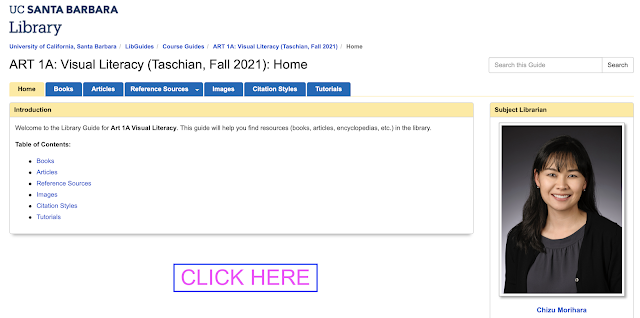
Your research materials should largely be procured from Davidson Library, and you will note that Chizu Morihara, our Art & Architecture Librarian, has created a special page for Art 1A Visual Literacy.

Art 1A Visual Literacy Library Homepage:

Other Helpful Library Resources:

Chizu Morihara is available to help you find your research materials for your Glenn Ligon research paper. Chizu can help you via email or Zoom. Email her for help, she is waiting to hear from you.
Chizu Morihara
UCSB Art & Architecture Library
Univ. of California, Santa Barbara
Santa Barbara, CA 93106-9010
(805) 893-2766